
Web3 banking in Europe is no longer a grey zone. It has a rulebook now. The EU’s Markets in Crypto-Assets Regulation (MiCA) replaces a patchwork of national approaches with one set of rules for digital assets, and that is a bigger shift than it sounds. MiCA will apply to over 450 million users across 27 countries, which hands enterprises something they have rarely had in crypto: a stable legal floor to build compliant financial products on.
Read it as a law if you like. Fintech firms, enterprises, and financial institutions should read it as an opening. With the rules spelled out, a business can plan, build, and ship MiCA-compliant platforms (crypto wallets, stablecoin payment rails, White Label Neo Banking Apps) without guessing what a regulator in the next country over will say.
This piece is written for B2B leaders who need to know how a MiCA-compliant Neo Banking product actually gets designed, built, and put in front of customers. Maybe you are scaling a fintech product. Maybe you are about to enter the EU for the first time. Either way, the window for being early is open right now, and it will not stay open.
So: what MiCA is, why the timing matters, and where to begin.
What Is MiCA and Why Does It Matter for Web3 Banking in Europe?
MiCA, the European Markets in Crypto-Assets Regulation, exists because crypto law across the EU was a mess. Every member state had its own take. Launching a white label crypto banking service in Europe meant working through a different set of expectations in each market, and staying compliant in all of them at once was hard work for any business.
MiCA ends that. One framework, applied the same way in every EU member state. It covers:
- Utility tokens
- Asset-backed tokens
- Stablecoins
- Crypto-asset service providers (CASPs)
Why should a Neo banking team care? Because one rulebook beats many. Legal risk drops, the road to market gets shorter, and scaling into a second or third country stops being a fresh legal project every time.
Launching a MiCA-compliant platform or a white-label neo bank solution is now faster and far more predictable. In a Web3 finance market that moves this quickly, predictability is exactly what gives first movers their edge.

Why Are Enterprises Launching Neo Banks in Europe Now?
If you were ever going to build a MiCA-compliant neo bank in Europe, this is the moment. Three things are pushing in the same direction at once:
1. Clear Regulations Are Finally in Place
MiCA is active. The legal clarity the industry spent years asking for is here, and enterprises can launch Web3 banking products knowing what compliance actually demands of them instead of guessing at it.
2. Faster Time to Market with White-Label Solutions
A white-label crypto banking service can take a company from idea to launch in a few months. Compare that with building every layer yourself. Time, cost, and risk all shrink. And for financial institutions trying to stay ahead of competitors, the right neo banking solutions buy months that a scratch build would burn.
3. Demand for Web3 Banking Is Growing Across the EU
Retail customers want better financial tools. So do businesses. DeFi integrations, stablecoin-based payments: the appetite is visible and it is growing quickly. Whoever offers MiCA-compliant platforms first gets to shape what users expect.
Are you a Blockchain company or someone who builds financial products? Then a MiCA-compliant white label neo banking app is worth putting on this year’s roadmap, not next year’s. The teams that move early win over early adopters and regulators, and that kind of trust is slow to earn later.
Read Also: Build a Crypto-Friendly Bank Like JP Morgan in 2025
What Is a MiCA-Compliant White-Label Neo Bank?
Think of it as a digital bank that is ready to go and already built around MiCA’s rules. The white-label part means a FinTech company can put its own brand on the product and sell it as its own bank, without writing the whole stack from the ground up.
A white-label setup gets your business into Web3 banking quickly because it comes with:
- Neo-banking app development tools that are already built
- Support for a high-quality smart contract
- Secure rails for crypto payments, lending, and digital asset custody
- Stablecoin features and multi-currency support out of the box
Put simply, it is the faster, safer, cheaper way to offer digital banking that lines up with European law. You skip the heavy lifting of a full in-house build.
What Does the Core Architecture of a MiCA Neo Bank Look Like?
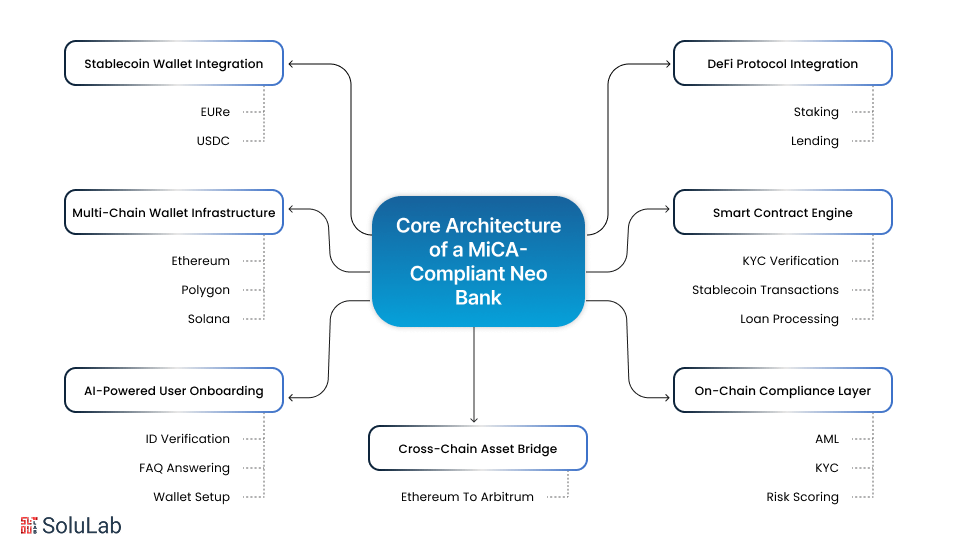
Security, compliance, and scale can’t be bolted on afterwards. They have to be there from the first line of the design. In most builds that means blockchain infrastructure underneath, with modular, plug-and-play components on top, so the product can satisfy users and European regulators at the same time.
The core pieces, layer by layer:
1. Multi-Chain Wallet Infrastructure
Users will want to hold more than one kind of digital asset, and move it. Multi-chain wallet integration handles that, giving smooth access to assets on Ethereum, Polygon, or even Solana.
2. Smart Contract Engine
This is the backend’s workhorse. Smart contracts run the automated parts: KYC verification, stablecoin transactions, loan processing. A good smart contract development company makes sure those contracts are secure, can be upgraded, and stay within MiCA norms.
3. On-Chain Compliance Layer
Here sit the modules MiCA expects: AML, KYC, risk scoring, transaction monitoring. Some teams write these checks straight into smart contracts. Others call a rules engine over APIs. White label crypto banking services need one approach or the other to stay within the law in real time.
4. AI-Powered User Onboarding
Onboarding is where a lot of sign-ups quietly die. AI agents take much of the friction out of it and out of support too: they check ID documents, answer the usual questions, set up wallets. Done well, AI agents cut costs sharply and make registration much faster.
5. Stablecoin Wallet Integration
No regulated stablecoins, no MiCA-compliant platform. Think MiCA-registered EURe or USDC, wired in through APIs and held to capital reserve standards. A specialist stablecoin development company keeps that integration clean and makes sure tokens are handled properly everywhere across your platform.
6. Cross-Chain Asset Bridge
One chain is not enough for a modern bank. Cross-chain bridges let assets move between blockchains (say, Ethereum to Arbitrum), so users get flexibility and you stay compliant.
7. DeFi Protocol Integration
Planning to offer staking, lending, or yield? Bring in a DeFi development company so the popular DeFi tools get wired in correctly. Keep each service modular and configurable, because that is how you keep it inside MiCA’s lines when the rules or the product shift.
Read More: Why the UAE Is the Best Location to Launch a Crypto Neo Bank?
How Do You Build a MiCA-Compliant White Label Neo Bank?
Code is the easy part. The real job is making sure the banking app behaves the way Europe’s new crypto and digital-asset rules say it must. A sensible order of work looks like this:
1. Partner with the Right Development Company
First, pick a dependable Blockchain development company that knows fintech and regulatory compliance equally well. That pairing is what keeps delays away and systems fast and secure.
2. Use Proven Banking Frameworks
Go with a Neo-banking app development stack that already does quick onboarding, flexible modules, and an architecture that scales.
3. Integrate Key Compliance Features
Build in secure identity checks (KYC/AML) and transaction monitoring, then add plug-in features such as:
- AI tools to catch fraud automatically and handle support
- Modules for asset-backed services
- Smart contract solutions that automate on-chain work securely
4. Follow MiCA Guidelines from Day One
Check the platform against MiCA’s standards for:
- User protection (transparency, how data is handled)
- Digital asset custody
- Clear reporting and licensing obligations
With a tech partner who has done this before, a MiCA-compliant Neo-Banking solution can go from idea to pilot in 10-12 weeks. Across Europe, that head start is worth a lot.
What Are the Best Practices for Neo Bank Development?
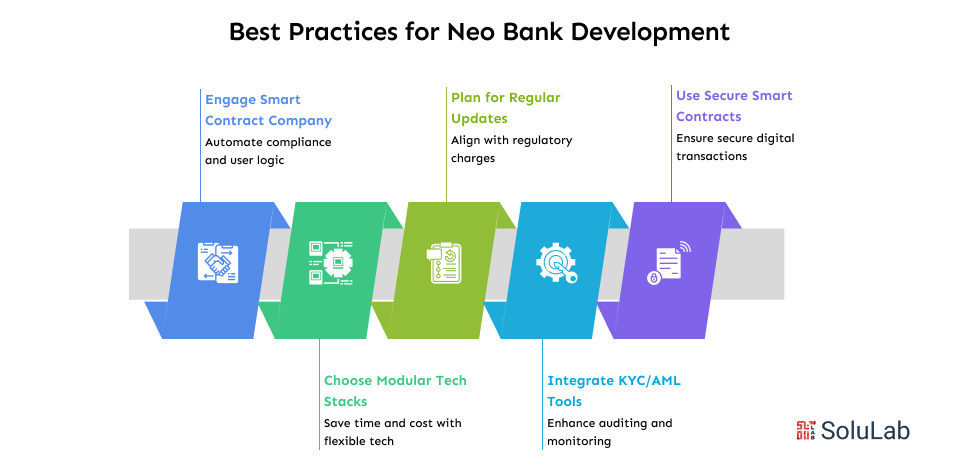
Speed alone won’t get a white-label neo bank to scale under MiCA. You need a plan. These are the habits that separate the launches that hold up from the ones that don’t:
- Bring in a reliable smart contract development company to automate compliance, onboarding, and core user logic.
- Pick modular, flexible tech stacks for strong blockchain development so you spend less time and money.
- Budget for regular updates, because Europe’s Markets in Crypto-Assets Regulation will keep changing
- Put advanced KYC, AML, and analytics tools in from day one. Audits and monitoring get much easier.
- Rely on secure, audited smart contracts for digital wallets, transactions, and stablecoin integrations.
Ticking the legal boxes is the minimum. The real prize is a regulation-first product that is still standing, and still growing with its customers, years from now.

Why Should You Start Building Now?
Wait, and the best openings in European Web3 banking go to someone else. Three reasons to start now:
- First-mover advantage: Launch one of the first fully MiCA-compliant banking platforms and you get into regulated markets across Europe early.
- Regulatory alignment: MiCA is the law now. Move today and you won’t be scrambling to catch up once enforcement gets stricter.
- Brand trust: Complying early earns credibility with users and regulators alike. People are simply more willing to sign up with a regulated product.
At SoluLab, a leading white label bank development company in the USA, we have built MiCA-compliant Neo-Banking solutions for multiple financial and fintech leaders: secure, scalable, and ready for the auditors.
You might be an established finance player, a fast-growing DeFi platform, or an eCommerce company looking at embedded finance. Whichever it is, a white-label neo bank solution lets you:
- Go live fast instead of starting from zero
- Stay focused on your business while we take care of the tech
- Grow across borders with full MiCA alignment
The rules are settled. Demand keeps climbing. What’s left is the build itself, and with a partner who has shipped one before, your own branded Web3 neo bank is a matter of weeks, not years. Contact us today!
FAQs
Neha is a curious content writer with a knack for breaking down complex technologies into meaningful, reader-friendly insights. With experience in blockchain, digital assets, and enterprise tech, she focuses on creating content that informs, connects, and supports strategic decision-making.